Rise & Shine — AI Productivity App
Built a cross-platform productivity app with integrated AI assistant, local-first sync, and voice interaction.
Product DevelopmentAI IntegrationCross-Platform Development
Key Results
Platforms Shipped
5
UI Response Time
<100ms
Offline Capable
100%
AI Responses
Sub-second
The Problem
Personal productivity apps force users into impossible choices:
- Comprehensive but complex — Notion, Obsidian require hours to set up and maintain
- Simple but fragmented — Using Todoist + Habitica + Day One means context-switching and scattered data
- AI-powered but cloud-dependent — Existing AI assistants raise privacy concerns for personal data
Users with ADHD or executive function challenges particularly struggle with managing multiple systems and the cognitive load of switching between apps.
Market gap
- No all-in-one solution combines tasks, habits, journaling, and relationships with AI
- Local-first + AI is rare — most AI apps require constant cloud connectivity
- Voice-first productivity is underdeveloped outside big tech assistants
The Intervention
We built Rise & Shine — a unified productivity app that replaces 5+ tools with one coherent experience:
Core features
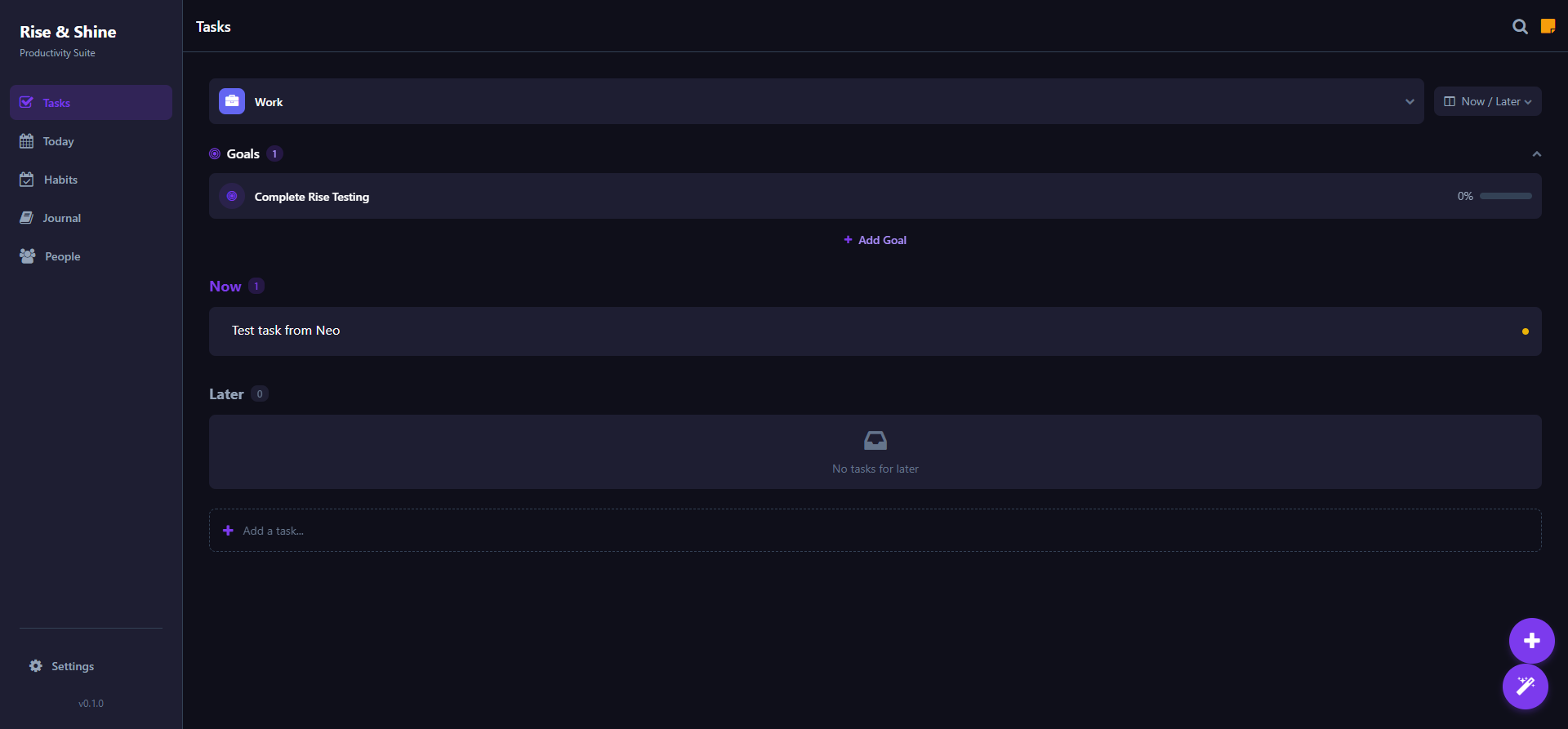
- Smart task management — Multiple workflows (Now/Later, Priority, Kanban) with goal tracking
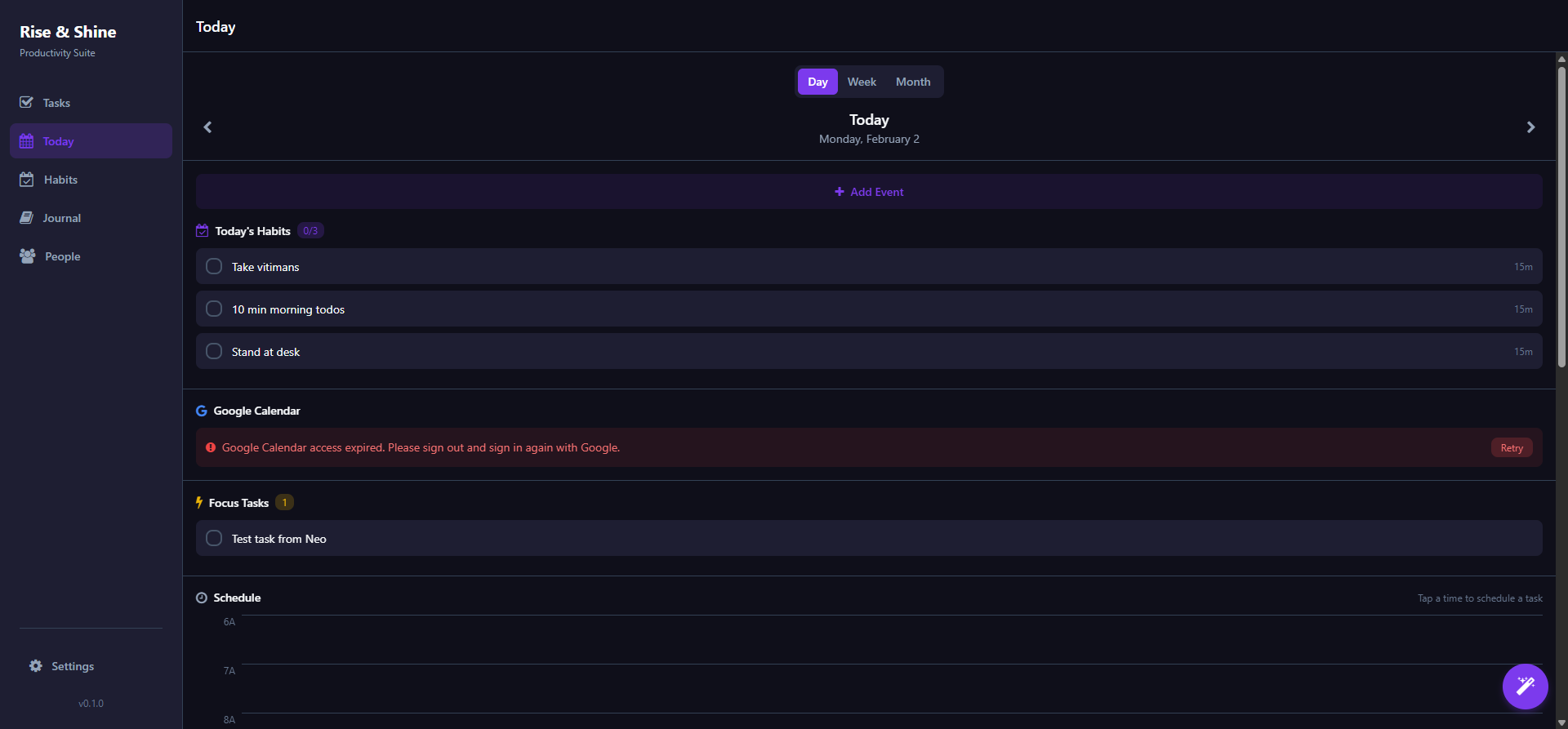
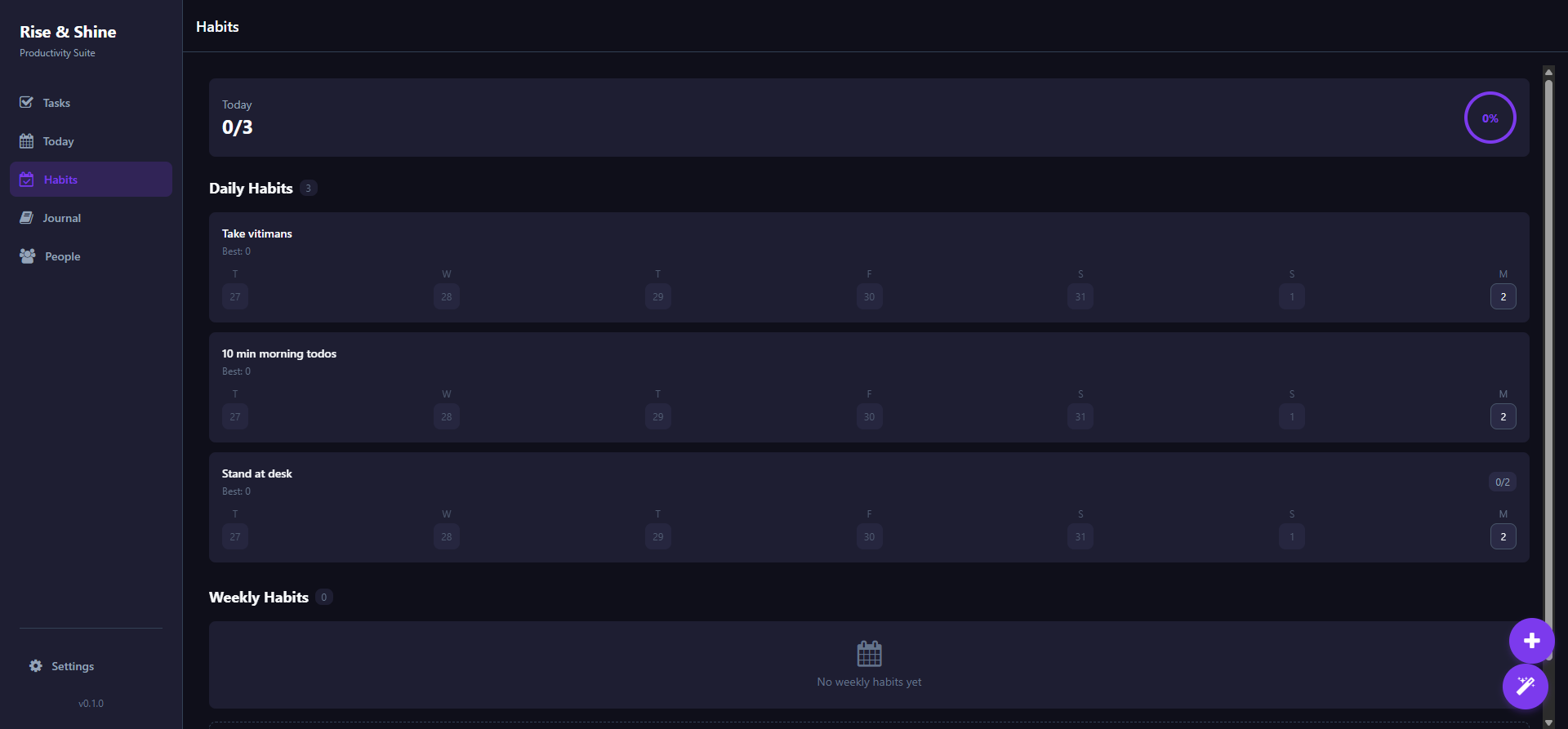
- Habit tracking — Streaks, flexible frequencies, morning/evening groupings
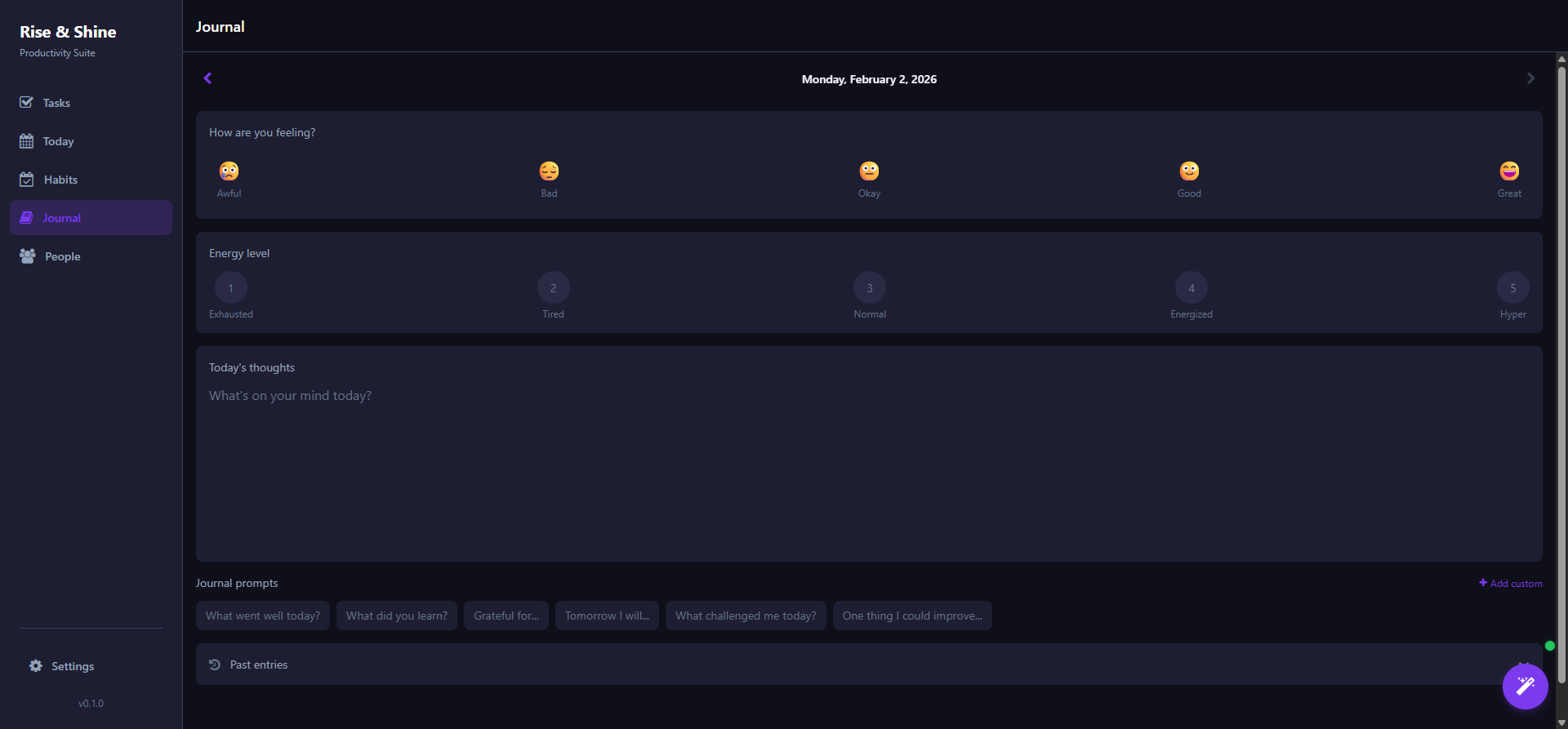
- Private journaling — Password protection, mood/energy tracking, custom prompts
- AI assistant — Natural language task creation, voice interaction, intelligent insights
- Relationship CRM — Contact frequency tracking, interaction logging
Technical architecture
React Native + Expo (Web/iOS/Android)
           ↓
     Zustand State
           ↓
   PowerSync (Local-First)
           ↓
 Supabase (PostgreSQL + Auth)
           ↓
 Gemini API (AI + Voice)
Stack
- Frontend: React Native, Expo SDK 54, NativeWind (Tailwind)
- State: Zustand with offline-first patterns
- Sync: PowerSync for local-first with automatic conflict resolution
- Backend: Supabase (PostgreSQL, Auth, Row-Level Security)
- AI: Google Gemini API with function calling
- Voice: Gemini Live API for real-time voice interaction
- Desktop: Tauri (Rust-based, ~45MB)
The Outcome
Delivered a production-ready MVP in 6 weeks:
- 5 platforms — Web, iOS, Android, Mac, Windows, Linux
- 100% offline capable — Works without internet, syncs when connected
- Under 100ms UI response — Local-first means instant interactions
- Sub-second AI responses — Gemini function calling for real actions
Key metrics
- Single codebase — 15 app screens, 42 TypeScript modules, 25 React components
- Zero cloud lock-in — Data exportable, architecture supports self-hosting
- Privacy-first — Optional password-protected journal, local AI ready (Gemma 3N)
Key Learnings
- PowerSync is production-ready — Local-first sync with Supabase worked flawlessly across platforms
- AI function calling > chat — Having AI take real actions (create tasks, log habits) is 10× more useful than just answering questions
- Expo + Tauri = desktop done right — Same React Native codebase wrapped in lightweight Rust for native desktop apps
- Voice UI is still hard — Real-time voice works, but latency and interruption handling need continued iteration
Screenshots
Project type: Internal product development
Timeline: 6 weeks to MVP
Demo: rise-neon.vercel.app
Tech Stack
React NativeExpo SDK 54NativeWindZustandPowerSyncSupabaseGoogle Gemini APIGemini Live APITauri